There is no Swiss Army Knife for every situation. Try as one might to anticipate every conceivable contingency, it’s simply not, well, in the cards.
Whether it’s the battlefield or the board room, our expertise, experiences, and unique skillsets can significantly increase our chances at succeeding at our mission. But the ever-present specter of chaos looms large. No matter how much you mitigate random chance, some element of it will always remain. You can design a foolproof research study, for instance, but you can’t completely ensure your participants will tell the truth 100% of the time. Likewise, you could become such a tactical mastermind as to give Sun Tzu a run for his money, but how were you to know a freak weather event would upend your chances? Gates are left unlocked, traffic jams happen, and gamers misinterpret rules. Indeed, the unforeseen is constantly swirling around us, ready to derail us in a myriad different ways.
The best laid plans of mice and men, as it were.
And that only takes into account systems that try to downplay luck. In something like Magic, luck isn’t just an obstacle to factor in – it’s part of the game’s makeup. When you play Magic, especially singleton formats where multiple copies of a card aren’t available to reduce said luck, randomness is something you must cope with. Regardless of how well designed your deck is, you’re going to have occasions where random chance works in your favor and times when it completely goes against you.
That also says nothing of taking anything your opponents do into account either.
Occasionally players gripe about the unpredictability of the game, espousing the notions that if mana were more reliably attained or decks were somehow more guaranteed to work that Magic would be better off. However, that argument doesn’t have much weight. As frustrating as being on the receiving end of a poor performance is, it also makes those games when you topdeck a much-needed answer that much more exciting.
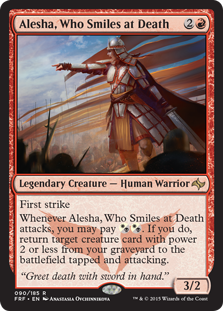
As it happens, both extremes were experienced in the first few Commander games played since we created our Alesha deck.
Epilogue
The final chapter of our collaborative deckbuilding exercise saw the completion of Alesha Who Smiles Back, a utility-friendly version of an Alesha EDH that focused primarily on taking advantage of her recursion ability but held back enough so that she wasn’t as crazy as to become a lightning rod whenever the deck hit the table.
[spoiler show=”Click to see Alesha Who Smiles Back”]
Alesha's Final Auditions
From numerous playtests and actual games played, I am happy to report that early indices all seem to back up that we achieved our goal. These are the cliffnotes of the first three games she saw play:
Game One:
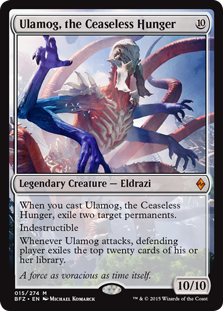
Alesha’s inaugural game was very mixed. It was a five player game which experienced numerous table power shifts. Alesha, however, did little until the latter stages of the game, due in no small part to a lack of Red mana. My opening hand had three land so I opted not to Partial Paris. Unfortunately, it took until Turn 8 to get the one Red mana needed to cast Alesha. This put me heavily behind all the other players for most of the game. Luckily, a pair of board wipes and far more problematic threats on the board allowed me to catch up, including a scary stompy Green deck, an Ulamog, the Ceaseless Hunger on the board, and an enchantment deck dropping an Avacyn, Angel of Hope.
Eep
Alesha ended up winning the game in the end thanks in large part to some table politics, Warstorm Surge and the timely appearances of Spike Cannibal and Knight-Captan of Eos, but it didn’t feel like it was deserved.
Random notes:
- Warstorm and the Captain both proved their worth. Similarly, Spike Cannibal was as good as I had hoped. However, since the writing of this series, Thief of Blood appeared in Commander 2015, raising an interesting conundrum. The Thief is even more powerful than the Cannibal as it affects all counters, but I’ll have to decide if that’s worth paying twice the mana to hard cast it (and losing the interaction with Mentor of the Meek).
- The deck’s initial mana problem was due to colorless mana-producing land. The deck only has 6/33 such lands, but without a lot of ramp and no mana rocks, attaining the right mana is important. It’s unsure after one game if it was bad luck or an actual problem.
- In the same vein, the game’s two biggest problems were Indesctructible creatures. The deck has a couple responses, but is it enough for my meta?
Game Two:
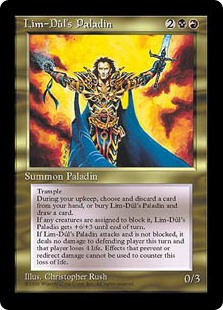
Alesha’s second game fared better. In this four player version, Alesha came out much quicker this time. I didn’t drop her immediately on Turn 3, though, for fear or drawing too much attention. Instead I set myself up with Sunforger, Spirit Bonds, and Lim-Dul’s Paladin before putting her out. I lacked the same amount of defense as the previous game, and so a couple early game swings met with predictable retaliation. Of course, this only fed the desire to up the tempo in response.
Hooray for oddities!
On the plus side, Alesha was able to strike some heavy damage, taking out one player thanks to Commander damage via an equipped Sunforger and a re-animated Silverblade Paladin. On the down side, I lost as a result of the other two players teaming up against me. At least I went down swinging.
Random notes:
- Sewer Nemesis is great for games of normal EDH length (which I prefer). In faster games, not so much. He sat most of the game in my graveyard due to being unable to properly build up his size.
- Lim-Dul is just as bizarre as I was hoping. At first it allowed me to discard creatures for Alesha to grab, but I was also able to sacrifice it to draw a card and then bring him back to do it again.
- It’s tough to say after one game, but I’m optimistic after seeing it in action that the fetchlands accomplish the ‘mana smoothing without artifacts’ idea I was hoping for.
Game Three:
Third time’s is the charm, apparently. I knew finding the right tempo for this deck was going to be tricky. The first one came out too slowly, the second too fast. This playthrough contained just the right amount of entertainment and power. In another four player bout, Alesha went up against several of the same decks seen in the first game.
Yay workhorses!
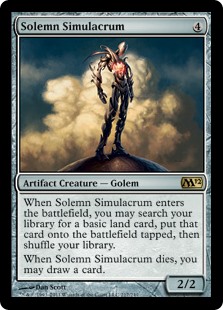
This time, though, the deck behaved on much better terms. I had a Dolmen Gate in my opening hand, and an early Buried Alive let me drop Solemn Simulacrum and Anger into my graveyard. Thus, when Alesha first came out, she already had an arsenal at the ready. As I figured, Sam worked out wonderfully. Later, I got to see the full force of how my army could grow in size in a hurry thanks to Necropolis Regent , proving it was a good choice in the end. It was a bit of a slugfest back and forth, and the game saw more than one total board wipe. Thankfully, Alesha was able to recover quickly and eeked out a well-earned win.
Random notes:
- Having my creatures chump blocked, regardless of size, could be something to watch for, as it happened a lot here. Sometimes people would block my smaller creatures just to not take damage, but dealing damage overall was uneven.
- The less I can have Alesha die, the better. She ended up getting cast from the Command Zone four times during this game, and she nearly died two others if not for Boros Charm and similar protections.
- I had Arcbond in my hand from the start of the game, and although there was one moment when I was considering doing game-ending damage to everyone thanks to a ridiculously-large Heroes’ Bane, it didn’t end up as necessary. Still, it was a nice grenade to have on standby if things turned south, and it seems like a number of the deck’s Instants have that vibe, which I’m happy about.
It will take more time to vet the deck properly, but even with limited empirical information after a few games, I’m happy to report that I believe our mission to be a resounding success. There are likely still areas in need of tinkering, and more testing will illuminate what those areas may be. In the meantime, I’ll be having fun finding out. Regardless of the game’s outcome, Alesha is quickly living up to being a very fun deck to play with – which is all one really can hope for in the end.
And with that, 2015 comes to a close. We’ll be back in 2016 in a return to series form showcasing some overlooked and offbeat Commander cards. Till then!